Category: Mortgage Payment

  • What Is a Mortgage? A Complete Guide to How Home Loans Work

    What Is a Mortgage? A Complete Guide to How Home Loans Work

    Buying a home is one of the biggest financial decisions most people ever make — and for the vast majority, it starts with a mortgage. But what exactly is a mortgage, and how does it work in practice? Whether you’re a first-time buyer trying to decode the jargon or someone who just wants a clearer picture before committing, this guide breaks down everything you need to know about mortgage loans, from the basic mechanics to the different types available.

    What Is a Mortgage?

    A mortgage is a type of loan specifically used to purchase real estate — most commonly a home. When you take out a mortgage, a lender (typically a bank, credit union, or mortgage company) provides you with the funds to buy the property. In return, you agree to repay the borrowed amount, plus interest, through regular monthly payments over a set period of time, usually 15 to 30 years.

    What makes a mortgage different from other loans is that the property itself serves as collateral. This means if you stop making payments, the lender has the legal right to take ownership of the home through a process called foreclosure. This arrangement reduces the lender’s risk, which is why mortgage interest rates tend to be lower than those on unsecured loans like personal loans or credit cards.

    The agreement between you and the lender is formalized in a document called a promissory note, which outlines your repayment terms, interest rate, loan duration, and other conditions.

    How Does a Mortgage Work?

    At its core, a mortgage lets you buy a home without paying the full purchase price upfront. Instead, you pay a portion of the price as a down payment and borrow the rest from a lender.

    Each month, your mortgage payment covers several components — commonly referred to by the acronym PITI:

    • Principal — the portion of your payment that goes toward reducing the actual loan balance.
    • Interest — the cost the lender charges you for borrowing the money, expressed as an annual percentage rate.
    • Taxes — property taxes assessed by your local government, often collected by the lender and held in an escrow account.
    • Insurance — homeowner’s insurance that protects the property, also frequently included in the escrow payment.

    Some borrowers also pay private mortgage insurance (PMI) if their down payment is less than 20% of the home’s purchase price. PMI protects the lender in case you default on the loan.

    How Amortization Works

    Most mortgages are fully amortizing loans, which means the loan will be completely paid off by the end of the term if you make all scheduled payments. However, the way payments are allocated shifts over time. In the early years, the bulk of each payment goes toward interest, with only a small fraction reducing the principal. As the loan matures, this ratio gradually reverses — more of each payment chips away at the balance, and less goes to interest.

    This process is what builds your home equity over time. Equity is the difference between your home’s current market value and the remaining balance on your mortgage. As you pay down the principal — and as property values potentially appreciate — your ownership stake in the home grows.

    Types of Mortgages

    Not all mortgages are created equal. The right loan type depends on your financial situation, credit profile, and long-term plans. Here’s a look at the most common types of mortgage loans available to borrowers.

    Fixed-Rate Mortgage

    A fixed-rate mortgage locks in one interest rate for the entire life of the loan. Your monthly principal and interest payment stays the same from the first month to the last, regardless of what happens in the broader economy.

    This predictability makes fixed-rate loans the most popular choice among homebuyers. They’re available in various term lengths, but the 15-year and 30-year options are by far the most common. A 30-year term gives you lower monthly payments but higher total interest costs. A 15-year term means higher monthly payments but significantly less interest paid overall.

    Adjustable-Rate Mortgage (ARM)

    An adjustable-rate mortgage starts with a lower introductory interest rate that remains fixed for an initial period — commonly 5, 7, or 10 years. After that, the rate adjusts periodically (typically once a year) based on market conditions.

    ARMs can be attractive if you plan to sell the home or refinance before the introductory period ends. However, they carry more risk because your monthly payment could increase substantially once the rate begins adjusting. Federal regulations require that all ARMs include lifetime caps that limit how much the interest rate can rise over the loan’s duration.

    Conventional Loan

    A conventional loan is any mortgage that isn’t backed by a government agency. These loans follow guidelines set by Fannie Mae and Freddie Mac and are the most common mortgage type in the market. They typically require higher credit scores (usually 620 or above) and larger down payments compared to government-backed loans.

    One advantage of conventional loans is flexibility — borrowers can cancel private mortgage insurance once they reach 20% equity in the home, which isn’t always possible with other loan types.

    FHA Loan

    Backed by the Federal Housing Administration, FHA loans are designed for borrowers who may not qualify for conventional financing. They allow credit scores as low as 580 with a down payment of just 3.5%, making them particularly popular with first-time homebuyers.

    The trade-off is that FHA loans require mortgage insurance premiums (MIP) — both an upfront payment at closing and an annual premium that’s added to your monthly payment. In many cases, this insurance remains for the life of the loan.

    VA Loan

    VA loans are guaranteed by the U.S. Department of Veterans Affairs and are available to eligible active-duty service members, veterans, and their surviving spouses. These loans often come with the most favorable terms of any mortgage type: no down payment requirement, no private mortgage insurance, and competitive interest rates.

    VA loans do require a one-time funding fee, but this can be rolled into the loan balance. For eligible borrowers, VA loans are widely considered one of the most cost-effective paths to homeownership.

    USDA Loan

    The U.S. Department of Agriculture backs USDA loans, which are aimed at homebuyers in eligible rural and suburban areas. Like VA loans, they offer zero-down-payment options and competitive rates. Borrowers must meet certain income limits to qualify, as the program is intended to support low-to-moderate-income households.

    Jumbo Loan

    When the home you want to buy exceeds the conforming loan limits set by the Federal Housing Finance Agency (FHFA), you’ll need a jumbo loan. These mortgages aren’t backed by Fannie Mae or Freddie Mac, so lenders assume more risk. As a result, jumbo loans typically require higher credit scores, larger down payments, and more robust income documentation.

    How to Get a Mortgage: The Application Process

    Applying for a mortgage involves several stages, and understanding the process helps you avoid surprises and move through it more efficiently.

    1. Check Your Financial Readiness

    Before you start house-hunting, take stock of your finances. Lenders evaluate three main factors: your credit score, your income and employment stability, and your existing debt. A higher credit score generally qualifies you for better rates. Paying down debt and avoiding new credit inquiries in the months leading up to your application can improve your position.

    2. Get Pre-Approved

    Pre-approval is when a lender reviews your financial documents — pay stubs, tax returns, bank statements, and credit history — and determines how much they’re willing to lend you. This step gives you a clear budget range and signals to sellers that you’re a serious buyer. The process typically takes one to three days.

    Pre-approval is different from pre-qualification, which is a less rigorous estimate based on self-reported financial information.

    3. Find a Home and Make an Offer

    With a pre-approval letter in hand, you can shop for homes within your budget. Once you find the right property and your offer is accepted, you move to the formal application stage.

    4. Submit Your Full Application

    At this point, you’ll provide detailed documentation to the lender, including the signed purchase agreement and proof of your earnest money deposit. The lender will issue a Loan Estimate — a standardized document that outlines projected costs, including your interest rate, estimated monthly payment, and closing costs.

    5. Underwriting and Approval

    During underwriting, the lender verifies everything you’ve submitted: income, employment, assets, debts, and the property’s appraised value. The underwriter’s job is to assess the level of risk involved in lending to you. This stage can take anywhere from a few days to several weeks.

    6. Closing

    Once you’re approved, you’ll attend a closing meeting where you sign the final paperwork, pay closing costs (typically 2%–5% of the loan amount), and officially take ownership of the property. From this point, your regular mortgage payments begin.

    What Factors Affect Your Mortgage Rate?

    Your mortgage interest rate isn’t a fixed number that applies to everyone — it’s influenced by a combination of personal and economic factors:

    • Credit score — borrowers with higher scores generally receive lower rates because they represent less risk to the lender.
    • Down payment size — a larger down payment reduces the lender’s exposure, which can translate to a better rate.
    • Loan term — shorter-term loans (like 15-year mortgages) typically carry lower interest rates than longer-term ones.
    • Loan type — government-backed loans sometimes offer more competitive rates than conventional mortgages.
    • Economic conditions — mortgage rates are influenced by the Federal Reserve’s policies, inflation, and the broader bond market. When the Fed raises rates, mortgage rates tend to follow.

    Mortgage vs. Other Types of Loans

    It’s easy to confuse a mortgage with other forms of borrowing, but there are key distinctions. Unlike a personal loan, a mortgage is a secured loan — the property acts as collateral. This security is what allows lenders to offer significantly lower interest rates and much longer repayment periods.

    A home equity loan or a home equity line of credit (HELOC), on the other hand, is a second loan taken against the equity you’ve already built in your home. These aren’t used to purchase a home — they tap into value that already exists.

    FAQ

    What is a mortgage in simple terms?

    A mortgage is a loan you take out to buy a home. The lender gives you the money to purchase the property, and you repay it over time with interest. The home itself secures the loan, meaning the lender can repossess it if you stop making payments.

    How much do I need for a down payment on a mortgage?

    It depends on the loan type. Conventional loans typically require 5%–20% down, though some allow as little as 3%. FHA loans require a minimum of 3.5%. VA and USDA loans may require no down payment at all for eligible borrowers.

    What credit score do I need to get a mortgage?

    Most conventional lenders look for a credit score of at least 620. FHA loans may accept scores as low as 580 (or even 500 with a larger down payment). VA and USDA loans don’t set a strict minimum, but most lenders prefer scores of 620 or higher.

    How long does it take to get approved for a mortgage?

    The mortgage process — from application to closing — generally takes 30 to 60 days. Pre-approval can happen within one to three days. The underwriting stage is typically the longest part, lasting anywhere from a few days to a few weeks depending on the complexity of your financial situation.

    What’s the difference between a fixed-rate and adjustable-rate mortgage?

    A fixed-rate mortgage keeps the same interest rate for the entire loan term, so your payment never changes. An adjustable-rate mortgage starts with a lower rate that stays fixed for an introductory period, then adjusts periodically based on market conditions — meaning your payment could go up or down.

    Can I pay off my mortgage early?

    Yes, most mortgages allow early repayment without a penalty. Making extra payments toward your principal can significantly reduce the total interest you pay and shorten your loan term. However, some loans do include prepayment penalties, so it’s important to check your loan agreement before making extra payments.

    What happens if I can’t make my mortgage payments?

    If you miss payments, your lender will typically reach out to discuss options. Many lenders offer forbearance programs or loan modification plans to help you get back on track. If payments remain unpaid, the lender can initiate foreclosure proceedings to recover the loan balance by selling the property.

    Is it better to rent or get a mortgage?

    There’s no universal answer — it depends on your financial stability, how long you plan to stay in one place, and local market conditions. Buying a home through a mortgage builds equity over time and can serve as a long-term investment. Renting offers more flexibility and doesn’t come with maintenance costs or the risk of property value decline. For many people, homeownership makes financial sense when they plan to stay for at least five to seven years.
  • Current Mortgage Rates Across Europe — A Comparison

    Current Mortgage Rates Across Europe — A Comparison

    Buying property in Europe means navigating a patchwork of mortgage markets, each shaped by local banking systems, central bank policy, housing supply, and regulatory tradition. A borrower in Malta can secure a home loan at barely 2%, while someone in Latvia pays more than double that — even though both countries share the same currency and the same central bank. Outside the eurozone, the picture stretches wider still, from competitive fixed-rate deals in the UK to double-digit rates in parts of Eastern Europe.

    This guide compares mortgage rates across major European countries, explains what drives the differences, and helps you understand the true cost of borrowing wherever you plan to buy. Run your own numbers through a mortgage calculator to see how each country’s rates translate into real monthly payments.

    European Mortgage Rate Snapshot: Where Things Stand in 2026

    The European Central Bank has cut its main refinancing rate from a peak of 4.50% down to 2.15% by early 2026, following a series of reductions that began in mid-2024. That easing cycle has filtered through to mortgage pricing across the eurozone, pulling the average rate on new home loans down to approximately 3.43% as of April 2026 — a meaningful improvement from the highs seen in late 2023.

    Outside the eurozone, central banks have followed their own paths. The Bank of England holds its base rate at 3.75% after cutting from 5.25%, with UK mortgage rates for 2- and 5-year fixed deals settling in the 4.3%–5.6% range. Switzerland continues to enjoy some of the lowest borrowing costs in Europe, while Poland and Hungary remain at the expensive end of the spectrum due to persistent domestic inflation pressures.

    The headline takeaway is that European mortgage rates have come down meaningfully from their 2023 peaks but remain well above the near-zero levels borrowers enjoyed before 2022. The variation between countries, however, is as wide as ever.

    Mortgage Rates by Country: A Full Comparison Table

    The following table compares average mortgage rates for new home loans across major European markets, based on data from the ECB, national central banks, and industry sources compiled through mid-2026.

    Eurozone Countries

    CountryAvg. Mortgage RateDominant TypeTypical Loan Term
    Malta~2.08%Variable25–40 years
    Bulgaria~2.47%Variable20–30 years
    Spain~2.80%Mixed/Fixed20–30 years
    Portugal~2.85%Mixed/Fixed30–40 years
    Croatia~2.95%Variable20–30 years
    Slovenia~2.99%Fixed15–20 years
    France~3.50%Fixed20–25 years
    Italy~3.60%Fixed20–30 years
    Belgium~3.47%Fixed20–25 years
    Austria~3.43%Fixed/Mixed20–30 years
    Netherlands~3.50%Fixed30 years
    Germany~3.84%Fixed10–15 years
    Finland~3.70%Variable20–25 years
    Ireland~3.80%Fixed25–35 years
    Lithuania~3.88%Variable20–30 years
    Estonia~4.05%Variable25–30 years
    Latvia~4.18%Variable20–30 years

    Non-Eurozone European Countries

    CountryAvg. Mortgage RateDominant TypeTypical Loan Term
    Switzerland~1.8%–2.2%Fixed/SARON10–15 years
    United Kingdom~4.4%–5.6%Fixed (2–5 yr)25–35 years
    Sweden~3.5%–4.0%Variable/Short fix50 years (amortized)
    Norway~4.5%–5.0%Variable25–30 years
    Denmark~3.5%–4.5%Fixed (30 yr)30 years
    Czech Republic~4.5%–5.0%Fixed (3–5 yr)20–30 years
    Romania~6.0%–6.5%Variable20–30 years
    Hungary~6.5%–7.0%Fixed/Mixed15–20 years
    Poland~7.0%–7.5%Variable25–35 years

    Rates change daily. Always verify the latest figures using a mortgage calculator and direct lender quotes before making decisions.

    Why Mortgage Rates Vary So Widely Across Europe

    A single percentage point might not sound like much, but the gap between Malta’s 2.08% and Latvia’s 4.18% — both eurozone members under the same ECB policy — translates into a massive difference in borrowing costs. Several structural factors explain the divergence.

    Fixed vs. variable rate dominance is the single biggest driver. In countries where variable-rate mortgages dominate — the Baltic states, Finland, and much of Scandinavia — rates respond quickly to ECB or central bank movements. When the ECB raised rates aggressively in 2022–2023, borrowers in Latvia and Estonia felt the impact almost immediately. In France, Spain, and Portugal, where fixed-rate loans prevail, borrowers locked in lower rates earlier and were shielded from the increases. ECB data shows variable-rate mortgages account for over 93% of new home loans in Latvia, Estonia, and Finland, compared to just 15% across the eurozone as a whole.

    Banking sector competition varies enormously. In large, mature markets like France, Germany, and the Netherlands, dozens of banks compete aggressively for mortgage business, which compresses margins and drives rates down. In smaller markets with fewer lenders — or where a handful of banks dominate — pricing power tilts toward the lenders.

    Covered bond markets also matter. Countries with deep covered bond markets — Germany, Denmark, France, and the Netherlands — can offer longer fixed-rate terms at lower spreads because lenders can fund mortgages cheaply through these instruments. Denmark’s covered bond system, in particular, enables 30-year fixed-rate mortgages at some of the most competitive rates on the continent.

    National regulation shapes both pricing and product design. Some countries cap loan-to-value (LTV) ratios at 80%, while others allow up to 100% in specific programs. Mandatory attorney involvement, mortgage recording taxes, early repayment penalties, and consumer protection rules all add friction that affects how lenders price their products.

    Macroeconomic conditions at the national level — wage growth, unemployment, housing market health, and default histories — feed into banks’ risk models and create country-specific risk premiums.

    Cheapest Mortgage Markets in Europe

    Several European countries stand out for offering unusually low borrowing costs in 2026.

    Malta leads the eurozone with average rates around 2.08%. The island’s mortgage market is small, dominated by variable-rate products, and benefits from strong economic growth, low unemployment, and conservative lending standards. Most Maltese mortgages are pegged to the ECB’s refinancing rate with a fixed margin, so borrowers benefit directly and immediately when the ECB cuts.

    Switzerland, outside the eurozone, consistently offers some of Europe’s cheapest mortgages thanks to its ultra-stable economy, low inflation, and deep capital markets. SARON-linked variable rates sit around 1.8%–2.2%, while 10-year fixed rates hover near 2.0%–2.5%. Swiss banks benefit from access to cheap domestic savings and a banking system with exceptionally low default rates.

    Spain and Portugal have become standout markets in the eurozone. Both countries shifted heavily toward fixed-rate mortgages after the 2008 crisis, and borrowers who locked in during the recent easing cycle are paying rates in the 2.8%–3.0% range. Spain’s legal framework, which caps early repayment fees at 0.25%–0.5% for variable-rate loans, makes refinancing easy and keeps the market competitive. Portugal allows loan terms up to 40 years for younger borrowers, which keeps monthly payments manageable despite rising property prices.

    Bulgaria and Croatia, newer eurozone members, also report low average rates — around 2.47% and 2.95% respectively — though their mortgage markets are smaller and product options more limited compared to Western European countries.

    Most Expensive Mortgage Markets in Europe

    At the opposite end of the spectrum, several countries impose significantly higher borrowing costs.

    Poland stands out with mortgage rates around 7.0%–7.5%, the highest among major European economies. The National Bank of Poland has kept its reference rate elevated relative to the ECB, and persistent inflation has delayed the easing cycle that much of the eurozone has already benefited from. Polish mortgages are predominantly variable-rate and denominated in zloty, leaving borrowers fully exposed to domestic monetary policy shifts.

    Hungary follows closely, with rates in the 6.5%–7.0% range. The Hungarian central bank cut its benchmark rate aggressively from 13% in 2023 to 6.25% by early 2026, but mortgage pricing has been slow to follow, partly because lenders are rebuilding margins after years of regulated rate caps. Hungary’s CSOK program offers subsidized loans for families with children, which can bring effective rates significantly below the market average.

    Romania reports rates around 6.0%–6.5%, driven by higher domestic inflation and a banking sector that prices in additional risk for a still-developing mortgage market. Variable-rate products dominate, tying borrowers to ROBOR fluctuations.

    The Baltic states — Latvia (4.18%), Estonia (4.05%), and Lithuania (3.88%) — are the most expensive within the eurozone itself. Their near-total reliance on variable-rate mortgages means ECB rate changes transmit instantly, and the small scale of their banking markets limits competitive pressure.

    The United Kingdom occupies a unique middle ground. While the best fixed-rate deals start around 4.3%–4.5% for well-qualified borrowers, the average 2-year fixed rate sits near 5.6% and the average standard variable rate exceeds 7%. The UK’s short fixed-rate periods (typically 2 or 5 years, versus 10–30 years in continental markets) mean that borrowers face regular remortgaging cycles, re-exposing them to rate risk more frequently than their European counterparts.

    How the ECB and Bank of England Shape European Rates

    The two most influential central banks for European mortgage borrowers are the European Central Bank and the Bank of England, and their recent policy paths tell contrasting stories.

    The ECB embarked on a decisive easing cycle starting in mid-2024, cutting its main refinancing rate from 4.50% to 2.15% by April 2026 through multiple reductions. This brought relief to eurozone borrowers, particularly those on variable-rate mortgages who saw their payments drop in near-real time. For fixed-rate borrowers, the impact is less direct — new loans became cheaper, but existing fixed-rate holders saw no change until their terms expired.

    The Bank of England followed a more cautious trajectory. After peaking at 5.25%, the base rate has been cut to 3.75% through a series of measured reductions. Markets expect further cuts at the September and November 2026 meetings, but persistent inflation concerns — partly driven by energy price volatility from Middle East tensions — have kept the BoE conservative. UK mortgage rates are influenced more by swap rates (the rates at which banks trade future interest rate commitments) than by the base rate directly, which is why mortgage pricing can sometimes diverge from BoE decisions.

    Outside these two blocs, the Swiss National Bank operates at the other extreme, with policy rates near 1.5%, explaining Switzerland’s rock-bottom mortgage costs. Scandinavian central banks have largely tracked the ECB’s direction, while Poland’s central bank has held rates stubbornly high, maintaining the gap between Polish and eurozone mortgage costs.

    The practical implication for borrowers: in countries where variable rates dominate, central bank decisions have a nearly immediate impact on monthly payments. In fixed-rate markets, the effect comes through with a lag — influencing new loans today but not existing ones.

    Fixed vs. Variable Rates: How European Countries Differ

    One of the most important structural differences across European mortgage markets is whether borrowers predominantly take fixed or variable rates — and for how long.

    Long-term fixed-rate cultures include France (20–25 year fixes are standard), Germany (10–15 year fixes dominate), Belgium, and the Netherlands (where 10–30 year fixes are common). In these markets, borrowers lock in their rate for most or all of the loan term, providing payment certainty but sometimes at a higher initial rate. France’s system is notable for allowing borrowers to fix for the entire loan duration at rates currently around 3.5% — among the best long-term deals in Europe.

    Short-term fixed-rate cultures include the UK, where 2- and 5-year fixes dominate the market, and several Scandinavian countries. UK borrowers face a remortgaging cycle every few years, re-negotiating their rate and potentially facing higher costs if market conditions have shifted. This creates ongoing uncertainty but also frequent opportunities to improve terms.

    Variable-rate dominant markets include Finland, the Baltic states, and much of Scandinavia. Sweden’s market historically favored 3-month variable rates, though there has been a gradual shift toward longer fixes in recent years. In these markets, monthly payments fluctuate directly with central bank decisions, creating both risk and upside for borrowers.

    Denmark deserves special mention for its unique covered bond-based system, which allows borrowers to take 30-year fixed-rate mortgages at rates that closely track government bond yields. Danish borrowers can also call (prepay) their mortgages at par when rates drop, effectively refinancing without penalty — a feature virtually unmatched elsewhere in Europe.

    Understanding which model your target country uses is essential for planning, because a “3.5% mortgage” in France (fixed for 25 years) represents a fundamentally different product than a “3.5% mortgage” in Finland (variable, repricing every 3–12 months).

    Buying Property as an Expat: What Rates Can You Expect?

    Non-residents and expats generally face higher mortgage rates and stricter qualification criteria than domestic buyers. The specifics vary by country, but certain patterns hold across Europe.

    Loan-to-value restrictions are typically tighter for non-residents. While a domestic buyer in Spain might borrow up to 80% LTV, a non-resident is usually capped at 60%–70%, requiring a larger down payment.

    Rate premiums of 0.3%–1.0% over domestic rates are common for non-resident mortgages, reflecting the additional risk lenders associate with borrowers who live abroad and may have income in a different currency.

    Documentation requirements are heavier. Expect to provide multiple years of tax returns, employment contracts, proof of foreign income, bank statements, and sometimes a credit report from your home country. Self-employed borrowers face even more scrutiny.

    Spain and Portugal are widely considered the most accessible markets for non-resident buyers, with well-established expat mortgage products and fixed rates in the 3.0%–3.5% range. France and Italy offer competitive rates but with more administrative friction. Germany and the Netherlands are accessible but require strong documentation and usually limit non-resident LTV to 60%–70%.

    For countries outside the eurozone, currency risk adds another layer of complexity. Taking a mortgage in a foreign currency exposes you to exchange rate fluctuations that can significantly affect your effective repayment cost.

    The True Cost of a Mortgage: Beyond the Interest Rate

    Comparing mortgage rates across countries requires looking beyond the headline number. Transaction costs, taxes, and structural differences in loan design can dramatically change the true cost of borrowing.

    • Closing costs vary from roughly 2%–3% of the property price in the UK and Netherlands to 10%–15% in Belgium, France, and Italy, where notary fees, registration taxes, and transfer duties are substantial.
    • Mortgage recording and stamp taxes are charged in several countries. The UK’s stamp duty land tax starts at 0% for the first £125,000 and scales up to 12% above £1.5 million (with higher rates for non-residents). Spain charges 6%–10% transfer tax on resales, while Germany’s property transfer tax (Grunderwerbsteuer) ranges from 3.5% to 6.5% depending on the federal state.
    • Early repayment penalties differ significantly. Italy banned them on new mortgages in 2007. Spain caps them at low levels. France allows penalties up to 3% of the outstanding balance or six months’ interest. Germany’s Vorfälligkeitsentschädigung (prepayment compensation) can be substantial if you exit a fixed-rate mortgage early, often amounting to several thousand euros.
    • Mandatory insurance and guarantee requirements add cost in some markets. France requires borrower life insurance (assurance emprunteur) on virtually all mortgages, adding 0.2%–0.5% to the effective annual cost. Some Dutch mortgages require participation in the National Mortgage Guarantee (NHG) scheme, which adds a one-time premium but provides safety-net protection.
    • Amortization rules also differ. In Sweden, new mortgages require mandatory amortization — borrowers must reduce their principal over time, even on the variable-rate products that dominate the market. In Switzerland, many mortgages are interest-only or require minimal amortization, which keeps monthly payments low but means the principal is never fully repaid during the loan term.

    To compare mortgages accurately across borders, use a mortgage calculator that accounts for rate, term, and amortization structure — not just the headline interest rate.

    European Mortgage Rate Trends: Where Are Rates Heading?

    The broad consensus for late 2026 and into 2027 is cautiously optimistic for borrowers, though the outlook varies by region.

    Eurozone rates are expected to remain stable or drift slightly lower if the ECB maintains its easing bias. Most forecasters project the 12-month Euribor — the benchmark for variable-rate mortgages — settling in the 2.2%–2.8% range through 2026, which should keep variable rates competitive. New fixed-rate mortgages may edge down modestly as well, though not dramatically unless economic conditions weaken significantly.

    United Kingdom mortgage rates could decline further if the Bank of England delivers the rate cuts markets expect in September and November 2026. The best fixed-rate deals may approach the 4.0% level for well-qualified borrowers, though average rates are likely to remain above 5% for most of the market. Swap rate volatility — particularly driven by inflation uncertainty and geopolitical risks — means UK rates can move independently of BoE decisions.

    Central and Eastern Europe presents a mixed picture. Poland’s central bank has signaled it may begin cutting in late 2026, which could bring meaningful relief to Polish borrowers paying 7%+. Hungary’s rates should continue declining as its earlier cuts work through the system. Romania’s rates depend heavily on inflation and fiscal policy developments.

    Switzerland and Scandinavia are likely to maintain their positions at the lower end of European rates, with modest movements in either direction depending on global economic conditions.

    The structural takeaway is that Europe’s mortgage rate landscape will remain highly fragmented. Where you buy, what currency you earn in, and whether you choose a fixed or variable product will continue to matter as much as — or more than — the headline policy rate.

    Frequently Asked Questions

    Which European country has the lowest mortgage rates?

    As of mid-2026, Malta offers the lowest average mortgage rates in the eurozone at approximately 2.08%, followed by Bulgaria at 2.47% and Spain at 2.80%. Outside the eurozone, Switzerland consistently offers the cheapest mortgages in Europe, with rates around 1.8%–2.5% depending on the product and term.

    How do European mortgage rates compare to US rates?

    European rates are generally lower than US rates. The average eurozone mortgage rate sits around 3.4%, compared to approximately 6.65% for a 30-year fixed mortgage in the US. However, direct comparison is complicated: US 30-year fixed mortgages have no equivalent in most European countries, where typical fixed terms range from 2 to 15 years, and many markets are dominated by variable-rate products.

    Can I get a mortgage in Europe as a non-resident?

    Yes, many European countries offer mortgages to non-residents, though with stricter terms. Expect lower LTV limits (typically 60%–70% vs. 80%+ for residents), slightly higher rates, and more extensive documentation requirements. Spain and Portugal are generally considered the most accessible markets for expat buyers.

    Are European mortgage rates expected to drop further in 2026?

    Modest further declines are possible, particularly in the eurozone where the ECB may continue its easing cycle. Variable-rate borrowers will benefit most from any additional ECB cuts. Fixed-rate borrowers taking new loans may see slightly better pricing. However, dramatic drops to pre-2022 levels are unlikely in the near term. In the UK, further Bank of England cuts are expected, which should gradually bring average mortgage rates down.

    Why are Baltic state mortgage rates higher than in Southern Europe?

    The Baltic states — Latvia, Estonia, and Lithuania — have mortgage markets overwhelmingly dominated by variable-rate products (over 93% of new loans). When the ECB raised rates, these borrowers felt the full impact immediately. In Southern Europe, particularly Spain, Portugal, and France, most borrowers hold fixed-rate mortgages that insulated them from rate hikes. Additionally, Southern European markets tend to have more lender competition, which compresses margins.

    What is the best fixed-rate mortgage term in Europe?

    It depends on where you’re buying. France offers fixed rates for the full 20–25 year loan term at competitive rates around 3.5%. Germany’s 10–15 year Zinsbindung is the market standard. Denmark’s covered bond system allows 30-year fixes at excellent rates. The UK typically offers 2- and 5-year fixes, with 10-year products available but less common. Generally, longer fixes cost slightly more per year but provide greater payment certainty.

    How much deposit do I need to buy property in Europe?

    Minimum deposit requirements vary. In the Netherlands and Denmark, 100% LTV is technically possible under certain programs. In Germany, Spain, and Italy, 80% LTV is standard, requiring a 20% deposit. France typically requires 10%–20% down. Non-residents should plan for 30%–40% of the property price in total cash, covering both the deposit and closing costs. Use a mortgage calculator to model different down payment scenarios and see how they affect your monthly repayments.

  • Current Mortgage Rates by U.S. State: A Comparison

    Current Mortgage Rates by U.S. State: A Comparison

    Mortgage rates are not one-size-fits-all. While national headlines report a single average, the rate you actually receive depends heavily on where you live. State-level differences in lender competition, housing demand, property taxes, regulatory costs, and local economic conditions create a patchwork of rates across the country — and the gap between the cheapest and most expensive states can mean tens of thousands of dollars over the life of a loan.

    This guide breaks down how mortgage rates vary by state, what drives those differences, and how to use this information to make a smarter borrowing decision. Use a mortgage calculator to see how even a small rate difference changes your monthly payment and total interest cost.

    National Mortgage Rate Overview in 2026

    Before diving into state-level data, it helps to know where the national averages stand. As of August 2026, the 30-year fixed-rate mortgage averages approximately 6.65% according to Freddie Mac’s Primary Mortgage Market Survey. The 15-year fixed-rate mortgage sits around 5.95%, and 5/1 adjustable-rate mortgages hover near 6.40%.

    These national figures have held relatively steady throughout the first half of 2026. The Federal Reserve has kept the federal funds rate in the 3.50%–3.75% range after a series of cuts in late 2024, and mortgage rates have remained in the mid-6% territory as a result. The spread between the 10-year Treasury note yield and the 30-year mortgage rate currently sits around 1.9 percentage points — wider than the historical average of 1.5%, reflecting ongoing market uncertainty.

    For individual borrowers, however, the national average is just a starting point. Your actual rate depends on your credit score, down payment, loan type, debt-to-income ratio, and — crucially — the state where the property is located.

    How Mortgage Rates Vary by State

    Mortgage rates across the 50 states typically span a range of 0.3 to 0.5 percentage points from lowest to highest. That may sound modest, but on a $350,000 loan over 30 years, a 0.4% rate difference translates to roughly $85 per month and over $30,000 in total interest.

    States with the lowest average rates tend to share certain characteristics: strong lender competition, stable housing markets, lower default histories, and borrower populations with higher average credit scores. Conversely, states with higher rates often have thinner lender pools, elevated foreclosure risk, or regulatory environments that increase the cost of lending.

    Here’s a snapshot of how average 30-year fixed mortgage rates break down by region, based on aggregated lender data from early-to-mid 2026.

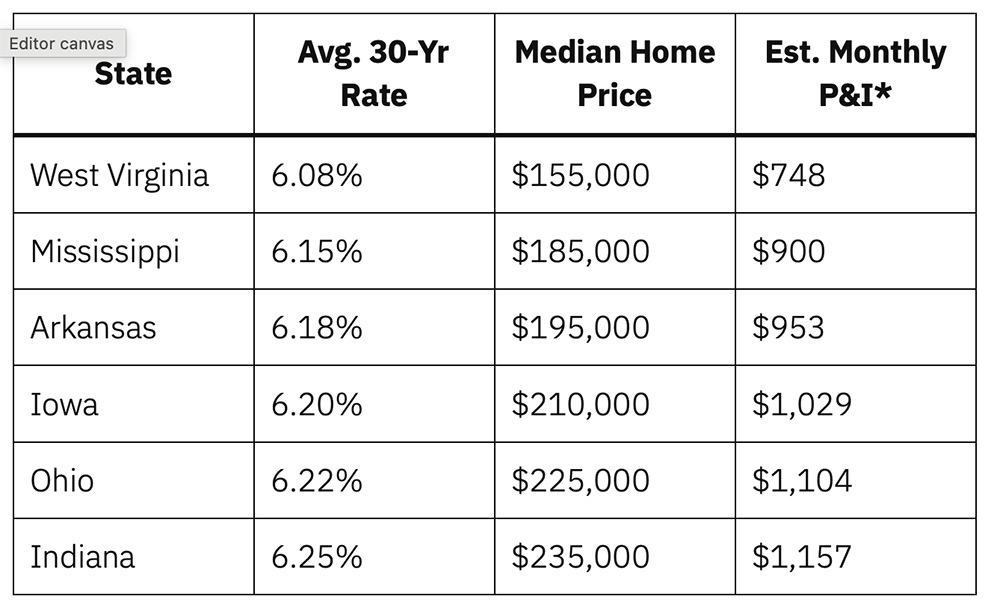
    Lowest-rate states (approximately 6.30%–6.45%):

    Lowest-rate states

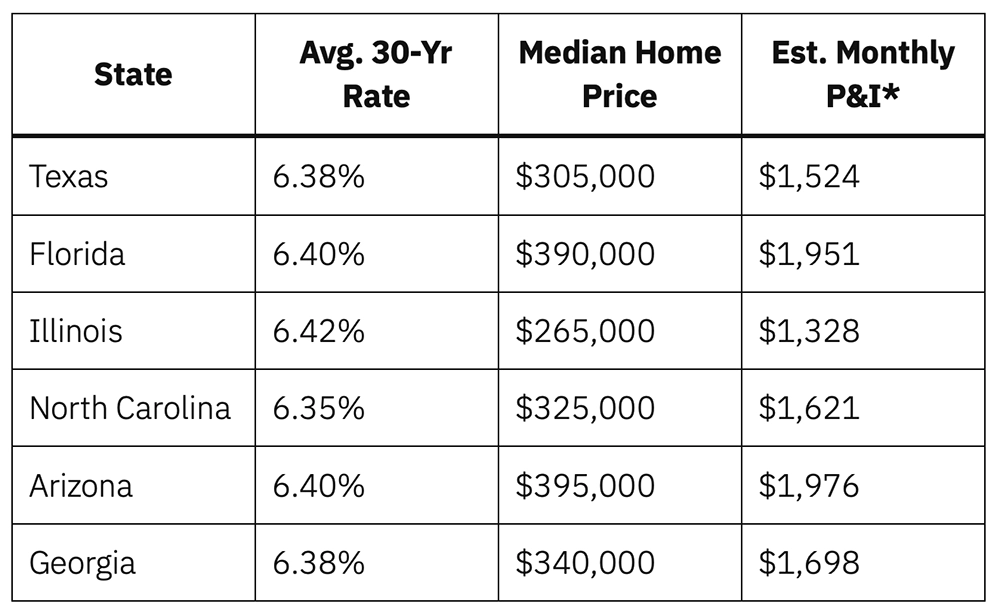
    Mid-range states (approximately 6.35%–6.50%):

    Mid-range states

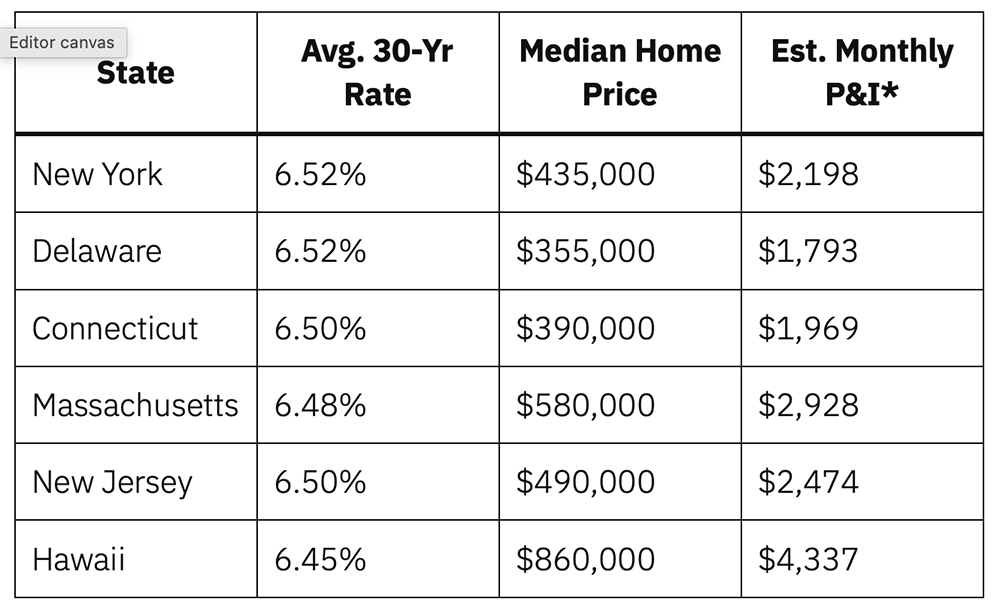
    Highest-rate states (approximately 6.45%–6.55%):

    Highest-rate states

    *Estimated monthly principal and interest based on a 20% down payment and a 30-year fixed-rate loan.

    These figures shift daily, so always check the latest rates using a mortgage calculator before making decisions.

    Why Mortgage Rates Differ From State to State

    The variation isn’t random. Several interconnected factors push rates higher or lower depending on where you’re buying.

    Lender competition is one of the biggest drivers. States with large populations and active housing markets — like California, Texas, and Florida — attract more lenders competing for business, which tends to push rates down. Smaller or more rural states with fewer lenders often see slightly higher rates because borrowers have fewer options.

    State regulations and closing costs also play a role. Some states require an attorney to be present at closing, impose mortgage recording taxes, or mandate specific types of title insurance. New York, for example, charges a mortgage recording tax that adds a direct cost to borrowing. These expenses don’t always show up in the interest rate itself, but they influence the overall cost of lending in that state and can affect how lenders price their products.

    Default risk and foreclosure history matter to lenders’ risk models. States with historically higher foreclosure rates or judicial foreclosure processes (which are slower and more expensive for lenders to resolve) may see slightly elevated rates as lenders price in the added risk. States with non-judicial foreclosure — where the process is faster and cheaper — typically offer marginally better rates.

    Housing market conditions including median home prices, inventory levels, and how quickly homes are selling all factor into lender risk assessments. In overheated markets where prices look stretched relative to incomes, lenders may add a slight premium.

    Borrower profiles vary by state too. States where the average borrower has a higher credit score, lower debt-to-income ratio, and larger down payment naturally see lower average rates — not because the state itself gets a discount, but because its borrowers are less risky on paper.

    State-by-State Mortgage Payments: The Full Cost Picture

    Interest rates tell only part of the story. The total monthly housing cost varies far more dramatically across states because of differences in home prices, property taxes, and insurance premiums.

    Consider two borrowers taking out a 30-year fixed mortgage with 20% down:

    Buyer in Mississippi:

    • Median home price: $185,000
    • Loan amount: $148,000
    • Rate: ~6.15%
    • Monthly P&I: ~$900
    • Property tax: ~$95/mo (0.77% effective rate)
    • Insurance: ~$130/mo
    • Total PITI: ~$1,125/month

    Buyer in Massachusetts:

    • Median home price: $580,000
    • Loan amount: $464,000
    • Rate: ~6.48%
    • Monthly P&I: ~$2,928
    • Property tax: ~$540/mo (1.12% effective rate)
    • Insurance: ~$145/mo
    • Total PITI: ~$3,613/month

    The Massachusetts buyer pays more than three times what the Mississippi buyer pays — driven primarily by home prices, not the 0.33% rate difference. This illustrates why looking at rates alone can be misleading. The true affordability picture requires factoring in all four PITI components.

    Property tax rates vary enormously. New Jersey leads the nation with an effective rate around 2.49%, which adds approximately $830 per month on a median-priced home. Hawaii, despite having the most expensive homes, has one of the lowest property tax rates at 0.28%, adding only about $200 per month. Texas has no state income tax but compensates with property tax rates near 1.80%, a significant hidden cost for homebuyers who focus only on the sticker price.

    How the Federal Reserve Impacts State-Level Rates

    The Federal Reserve doesn’t set mortgage rates directly, but its monetary policy decisions ripple through the entire lending market and affect rates in every state simultaneously.

    When the Fed adjusts the federal funds rate — the overnight borrowing rate between banks — it influences short-term interest rates across the economy. Adjustable-rate mortgages are most directly affected, since their rates are tied to indexes like the Secured Overnight Financing Rate (SOFR) that move closely with Fed policy.

    Fixed-rate mortgages are influenced more indirectly. They track the yield on the 10-year U.S. Treasury note, which responds to investors’ expectations about future inflation, economic growth, and Fed policy direction. When investors expect higher inflation or more government borrowing, Treasury yields rise and mortgage rates follow.

    In 2026, the Fed has held its rate steady after cutting by a total of 1 percentage point in late 2024. Markets currently expect one or two additional cuts later in the year, but ongoing inflation concerns — partially driven by geopolitical instability and trade policy — have kept mortgage rates elevated. If the Fed does cut again, rates could ease across all states, though the relative differences between states would likely remain similar.

    Most Affordable States to Buy a Home in 2026

    Affordability combines mortgage rates, home prices, and local costs into what matters most: how much of your income goes toward housing. Here are the states where homeownership currently stretches the furthest:

    1. West Virginia consistently ranks as the most affordable state for homebuyers. Low median home prices around $155,000 combined with some of the lowest average mortgage rates in the country keep monthly payments well under $1,000 for a typical purchase. Property taxes are moderate, and insurance costs are below the national average.
    2. Mississippi offers median home prices near $185,000 and competitive rates around 6.15%. The state’s lower cost of living means that even with modest household incomes, many families can comfortably afford homeownership.
    3. Arkansas, Oklahoma, and Iowa round out the top five most affordable states, all featuring median home prices below $220,000 and average rates in the 6.15%–6.25% range. In these markets, a household earning the area median income can typically qualify for a mortgage with room to spare in the budget.
    4. Ohio and Indiana deserve mention for offering affordable homeownership in states with more diversified economies and access to major metro areas. Cities like Columbus, Indianapolis, and Cincinnati provide urban amenities at a fraction of coastal housing costs.

    At the opposite end, Hawaii, California, Massachusetts, Washington, and Colorado present the greatest affordability challenges. In Hawaii, the median home price exceeds $860,000, pushing the average PITI payment above $5,000 per month even with relatively moderate interest rates.

    Most Expensive States for Mortgage Borrowers

    The most expensive states for mortgage borrowers aren’t always the ones with the highest interest rates — they’re the ones where the combination of home prices, taxes, and insurance creates the heaviest total burden.

    Hawaii tops the list with a median home price around $860,000 and average monthly PITI payments exceeding $5,000. Limited land supply, geographic isolation, and high construction costs keep prices persistently elevated.

    California follows closely, with coastal markets like San Francisco, Los Angeles, and San Diego pushing the statewide median above $750,000. While inland areas are more affordable, the state average remains among the highest in the nation.

    Massachusetts and New Jersey combine high home prices with substantial property taxes. In New Jersey, the effective property tax rate of approximately 2.49% means a homeowner with a $490,000 property pays over $12,000 annually in taxes alone — money that comes on top of the mortgage payment.

    New York presents a split picture. New York City and its surrounding suburbs are among the most expensive markets in the country, while upstate areas are far more affordable. The statewide average rate of around 6.52% is among the highest, and the mortgage recording tax adds a direct cost to every purchase.

    Connecticut and Washington also rank in the top tier of expensive states, driven by proximity to major employment centers, limited housing supply, and strong demand from high-income buyers.

    How to Get the Lowest Mortgage Rate in Your State

    Regardless of where you live, you have significant control over the rate you receive. The state average is just a benchmark — individual borrowers routinely beat it by following smart strategies.

    • Shop multiple lenders. This is the single most impactful step. Research consistently shows that borrowers who compare offers from at least three to five lenders save an average of $1,500 or more over the life of their loan. Rates can vary by 0.5% or more between lenders in the same market on the same day for the same borrower profile.
    • Strengthen your credit score. Your FICO score is the most powerful rate lever you control. Borrowers with scores above 760 routinely receive rates 0.5% to 1.0% lower than those with scores in the 620–680 range. On a $300,000 loan, that difference saves $100–$200 per month.
    • Increase your down payment. Putting 20% or more down eliminates PMI and typically qualifies you for the best available rates. Even moving from 10% to 15% down can improve your rate offer.
    • Consider buying mortgage points. Paying upfront discount points (each point costs 1% of the loan amount and typically reduces your rate by 0.25%) makes sense if you plan to stay in the home long enough to recoup the cost. On a $400,000 loan, one point costs $4,000 and saves roughly $60 per month — breaking even in about 5.5 years.
    • Lock your rate strategically. Mortgage rates move daily. Once you find a rate you’re comfortable with, lock it in — most lenders offer 30- to 60-day rate locks at no extra cost. If you’re in a falling-rate environment, a shorter lock period gives you flexibility; if rates are volatile or rising, lock early.
    • Explore different loan types. FHA, VA, and USDA loans often carry lower rates than conventional mortgages. VA loans in particular typically offer the lowest rates available — often 0.25% to 0.5% below conventional — and require no down payment or PMI.

    Use a mortgage calculator to compare how different rates, terms, and down payment amounts affect your total borrowing cost before committing.

    High-Cost vs. Low-Cost Areas Within the Same State

    State averages can obscure dramatic differences within a state’s borders. Many states contain both affordable markets and some of the priciest real estate in the country.

    California is the textbook example. The median home price in San Francisco exceeds $1.2 million, while the median in Bakersfield or Fresno falls below $350,000. Borrowers in high-cost metros may need jumbo loans (above the conforming limit of $832,750 in most areas), which carry different rates and qualification standards.

    New York shows a similar split. Manhattan and Brooklyn are among the most expensive ZIP codes in America, while cities like Syracuse and Buffalo offer homes at a fraction of the price. The conforming loan limit is higher in designated high-cost areas, which can keep more borrowers in the conventional loan market where rates are typically more competitive.

    Florida ranges from relatively affordable markets like Jacksonville and Tallahassee to premium coastal areas like Miami, Naples, and Key West. Insurance costs — particularly for windstorm coverage — add a state-specific burden that varies significantly by county and proximity to the coast.

    Texas offers affordable homeownership in many markets, but its high property tax rates (averaging around 1.80%) offset the absence of a state income tax. A home in Austin costs roughly twice what the same square footage goes for in San Antonio, yet both carry similar mortgage rates.

    Understanding these intra-state dynamics is important because the conforming loan limit, available lenders, and local competition all change based on your specific market — not just your state.

    Mortgage Rate Trends: Where Are Rates Heading?

    Predicting mortgage rates with precision is impossible, but understanding the factors that drive them helps you make better timing decisions.

    The consensus among mortgage industry analysts heading into late 2026 is that 30-year fixed rates will likely remain in the 6.25%–7.00% range for the near term. Several factors support this forecast.

    Inflation remains above the Fed’s 2% target, partly fueled by energy price volatility linked to geopolitical tensions. Until inflation convincingly declines, the Fed is unlikely to cut rates aggressively, which keeps the floor under mortgage rates.

    Government borrowing is elevated. High federal deficits require the Treasury to issue more bonds, pushing yields up and dragging mortgage rates higher. This structural pressure is unlikely to ease quickly.

    Housing demand is resilient. Despite affordability challenges, demographic factors — particularly millennials entering their prime home-buying years — keep demand strong. High demand supports higher rates because lenders don’t need to lower prices to attract business.

    On the positive side, if economic growth slows meaningfully or inflation drops faster than expected, mortgage rates could decline more quickly. Some forecasters project rates reaching the 5.80%–6.20% range by mid-2027 if conditions align.

    For buyers, the practical takeaway is straightforward: trying to time the market is risky. If you find a home you can afford at today’s rates, buying now and refinancing later if rates drop is generally a sounder strategy than waiting for a rate dip that may not come.

    Frequently Asked Questions

    Which state has the lowest mortgage rates right now?

    West Virginia consistently reports among the lowest average 30-year fixed mortgage rates in the country, recently averaging around 6.08%. Mississippi, Arkansas, and Iowa also rank among the most affordable states for mortgage borrowing. Keep in mind that individual rates depend on your credit profile, not just your state.

    Why are mortgage rates different in each state?

    Rates vary due to differences in lender competition, state regulations and closing costs, local economic conditions, foreclosure laws, and the average creditworthiness of borrowers in each state. States with more lenders competing for business and lower regulatory costs tend to have lower average rates.

    Does my state affect my mortgage rate more than my credit score?

    No. Your credit score has a much larger impact on your individual rate than your state does. The state-to-state rate variation is typically 0.3–0.5 percentage points, while the difference between excellent credit (760+) and fair credit (620–680) can be 0.5–1.0 percentage points or more. Focus on improving your credit profile first.

    What is the conforming loan limit for 2026?

    The conforming loan limit for most of the U.S. is $832,750 for a single-family home in 2026. In designated high-cost areas — including parts of California, New York, Hawaii, and Washington, D.C. — the limit can be higher. Loans exceeding the conforming limit are classified as jumbo loans and may carry different rates.

    How can I find the best mortgage rate in my state?

    Compare offers from at least three to five lenders, including banks, credit unions, and online lenders. Check your credit score and address any issues before applying. Consider different loan types (conventional, FHA, VA, USDA) and use a mortgage calculator to evaluate how each offer affects your total borrowing cost over the full loan term.

    Are mortgage rates expected to drop in 2026?

    Modest declines are possible if the Federal Reserve resumes cutting the federal funds rate later in 2026, but most analysts expect 30-year rates to remain in the mid-6% range through the end of the year. A more meaningful decline — into the high 5% range — is considered more likely for mid-to-late 2027, depending on inflation and economic conditions.

    Should I wait for lower rates before buying a home?

    Timing the mortgage market is notoriously difficult. If you’ve found a home you can afford at current rates, buying now and refinancing later if rates drop is typically a more reliable strategy than waiting indefinitely. Home prices may continue to rise while you wait, potentially offsetting any savings from a lower rate.

  • What Is a Reverse Mortgage and How Does It Work?

    What Is a Reverse Mortgage and How Does It Work?

    For many retirees, the house they’ve spent decades paying off is their single largest asset — yet that wealth is locked inside the walls. A reverse mortgage unlocks it, turning home equity into usable cash without requiring you to sell or move. It’s a powerful financial tool, but it comes with rules, costs, and risks that every borrower should understand before signing.

    This guide explains how reverse mortgages work, who qualifies, what they cost, and when they make sense — so you can decide whether one belongs in your retirement plan.

    How Does a Reverse Mortgage Work?

    A reverse mortgage flips the traditional lending model. Instead of making monthly payments to a lender, the lender pays you — drawing from the equity you’ve built in your home. You retain ownership and continue living in the house, but the loan balance grows over time rather than shrinking.

    Here’s the basic mechanics. You borrow against your home’s appraised value minus any remaining mortgage balance. The lender sends you money as a lump sum, a line of credit, fixed monthly payments, or a combination. Interest accrues on every dollar disbursed and compounds monthly, so the amount you owe increases steadily. The loan comes due when you sell the home, move out permanently, or pass away — at which point the home is typically sold and the lender is repaid from the proceeds.

    No monthly mortgage payments are required while you live in the home. You do, however, remain responsible for property taxes, homeowners insurance, and basic maintenance. Falling behind on any of these can trigger a default.

    Types of Reverse Mortgages Available

    Not all reverse mortgages are the same. Three main types exist, each suited to different situations.

    Home Equity Conversion Mortgage (HECM) is by far the most common. It’s insured by the Federal Housing Administration (FHA) and regulated by the U.S. Department of Housing and Urban Development (HUD). HECMs have borrowing limits set annually by FHA — for 2024, the maximum claim amount is $1,149,825. Because they’re federally insured, HECMs offer consumer protections that proprietary products don’t, including mandatory counseling before closing.

    Proprietary reverse mortgages are private loans offered by individual lenders. They aren’t federally insured, which means fewer regulatory guardrails — but they allow borrowers with high-value homes to access equity beyond the HECM limit. If your home is worth $2 million or more, a proprietary product may unlock significantly more cash.

    Single-purpose reverse mortgages are offered by some state and local government agencies and nonprofits. They’re the least expensive option but restrict how you can use the funds — usually for one specific purpose like home repairs or property tax payments. Availability varies by location.

    Who Qualifies for a Reverse Mortgage?

    Eligibility requirements for a HECM reverse mortgage are straightforward but strict.

    Age: At least one borrower must be 62 or older. If both spouses are on the loan, the younger spouse’s age determines the borrowing limit — younger means a smaller payout.

    Home ownership: You must own the home outright or have a small remaining mortgage balance that can be paid off with reverse mortgage proceeds at closing.

    Primary residence: The home must be your primary residence. Vacation homes, rental properties, and investment properties don’t qualify.

    Property type: Eligible property types include single-family homes, FHA-approved condos, manufactured homes built after June 1976 that meet HUD standards, and multi-unit properties (up to four units) where you occupy one.

    Financial assessment: Since 2015, HECM lenders conduct a financial assessment to verify you can cover ongoing property charges — taxes, insurance, HOA fees, and maintenance. If you fall short, the lender may set aside a portion of your loan proceeds in a “Life Expectancy Set-Aside” (LESA) to cover these costs.

    Counseling: Before applying, you must complete a session with a HUD-approved reverse mortgage counselor. This is mandatory and designed to ensure you understand the product’s terms and alternatives.

    How Much Money Can You Get From a Reverse Mortgage?

    The amount you can borrow depends on several factors working together. Your age plays a major role — older borrowers qualify for a higher percentage of their home’s value because the expected loan duration is shorter. Current interest rates matter too: lower rates mean higher payouts.

    The home’s appraised value sets the ceiling, subject to the FHA lending limit for HECMs. Your existing mortgage balance is subtracted, since it must be paid off first. Upfront costs — origination fees, mortgage insurance premiums, and closing costs — also reduce the net amount you receive.

    As a rough benchmark, borrowers in their mid-60s to early 70s typically access between 40% and 60% of their home’s value. An 80-year-old with a fully paid-off home will qualify for considerably more. To estimate your specific payout, try running the numbers through a mortgage calculator that supports reverse mortgage scenarios.

    Reverse Mortgage Payout Options Explained

    HECM borrowers can choose how they receive funds, and the flexibility here is one of the product’s strongest features.

    1. Lump sum delivers the full available amount at closing. This is the only option available with a fixed interest rate. It works well when you need a large amount immediately — to pay off an existing mortgage, cover a major medical expense, or fund a specific purchase. The risk is spending too much too quickly.
    2. Line of credit gives you access to funds on demand, similar to a home equity line of credit. The unused portion grows over time at the same rate as the loan balance, effectively increasing your borrowing power the longer you wait. Many financial planners consider this the most strategically valuable option.
    3. Monthly tenure payments provide equal payments for as long as you live in the home, regardless of how long that turns out to be. This works like a private pension funded by your house.
    4. Monthly term payments deliver equal payments for a fixed period you choose — say, 10 or 15 years. Payments are higher than tenure because they’re compressed into a shorter window.
    5. Combination mixes a line of credit with monthly payments, letting you tailor cash flow to your needs. For example, you might take a partial lump sum to eliminate an existing mortgage, set up modest monthly payments for everyday expenses, and keep the rest as a growing credit line for emergencies.

    How Much Does a Reverse Mortgage Cost?

    Reverse mortgages carry higher upfront costs than traditional home loans. Understanding these fees helps you evaluate whether the product is worth it for your situation.

    Origination fee: Lenders can charge the greater of $2,500 or 2% of the first $200,000 of home value plus 1% of the amount above $200,000, capped at $6,000.

    Initial mortgage insurance premium (MIP): 2% of the home’s appraised value (or the FHA lending limit, whichever is lower), paid at closing. On a $400,000 home, that’s $8,000.

    Ongoing mortgage insurance premium: 0.5% of the outstanding loan balance per year, added monthly to what you owe. This premium is what funds the FHA’s non-recourse guarantee.

    Closing costs: Standard third-party fees — appraisal, title search, title insurance, recording fees, and surveys — typically ranging from $2,000 to $5,000 depending on location.

    Interest: Accrues on every disbursed dollar and compounds monthly. With adjustable-rate HECMs, the rate is tied to an index (usually the 1-year CMT or SOFR) plus a margin. Fixed-rate HECMs lock the rate but require a full lump-sum draw.

    Servicing fee: Some lenders charge a monthly servicing fee, capped at $30 for annually adjustable rates and $35 for monthly adjustable rates under FHA rules.

    Most of these costs can be financed into the loan rather than paid out of pocket, but that means they eat into your available equity from day one.

    The Non-Recourse Protection: Why It Matters

    One of the most important features of a HECM reverse mortgage is its non-recourse clause. This means you — or your heirs — will never owe more than the home is worth at the time of repayment, even if the loan balance has grown larger than the home’s market value.

    Here’s how that plays out in practice. Suppose you borrow against a home valued at $350,000. Over 15 years, accumulated interest and fees push the loan balance to $420,000, but the home’s market value has only risen to $380,000. When the loan comes due, the maximum repayment is $380,000 — the FHA insurance fund absorbs the $40,000 shortfall. Neither you nor your estate is liable for the difference.

    This protection exists because of the mortgage insurance premiums you pay (both the 2% upfront and the ongoing 0.5% annual charge). It’s a significant safeguard, especially in uncertain housing markets.

    Reverse Mortgage vs. Home Equity Loan: Key Differences

    Both products let you tap home equity, but they serve different needs and carry different obligations.

    home equity loan or HELOC gives you a lump sum or credit line at relatively low cost, but you must make monthly payments — principal and interest — starting immediately. You need sufficient income to qualify, and missing payments puts your home at risk of foreclosure. These products work best for working-age homeowners with steady income who want short-term access to equity.

    reverse mortgage eliminates monthly payment obligations and doesn’t require income qualification in the traditional sense. But the costs are higher, the loan balance grows over time, and you’re consuming equity that would otherwise pass to your heirs. It’s designed for retirees who need cash flow or a financial safety net and plan to stay in their home long-term.

    The right choice depends on your age, income, how long you plan to stay, and whether preserving equity for heirs is a priority. Comparing both options using a mortgage calculator can clarify the long-term financial impact of each path.

    When a Reverse Mortgage Makes Sense

    A reverse mortgage isn’t right for everyone, but it solves real problems in specific situations.

    • Supplementing retirement income. If your savings and Social Security don’t cover monthly expenses, a reverse mortgage can fill the gap without forcing you to sell your home or liquidate investments at a bad time.
    • Eliminating an existing mortgage payment. Using reverse mortgage proceeds to pay off a remaining traditional mortgage frees up cash flow immediately. This is one of the most common uses.
    • Delaying Social Security. Drawing from home equity in your early 60s allows you to delay claiming Social Security benefits until age 70, when the monthly payout is significantly higher. The math on this strategy often works strongly in the borrower’s favor.
    • Creating a financial safety net. A HECM line of credit that sits untouched grows over time. Establishing one early — when you don’t need it — gives you a larger cushion later for unexpected medical expenses, home repairs, or market downturns that deplete other assets.
    • Aging in place. If your home needs accessibility modifications — a first-floor bathroom, a wheelchair ramp, wider doorways — reverse mortgage funds can pay for them, allowing you to stay in a familiar environment rather than moving to assisted living.

    Risks and Drawbacks You Should Know

    No financial product is without downsides, and reverse mortgages have several that deserve careful attention.

    Eroding equity. Because interest compounds on a growing balance, your home equity shrinks over time. If you live in the home for 20+ years, the loan could consume most or all of your equity, leaving little for heirs.

    High upfront costs. The combination of origination fees, mortgage insurance, and closing costs makes reverse mortgages expensive to initiate — especially if you move or repay the loan within a few years.

    Impact on benefits. While reverse mortgage proceeds aren’t considered taxable income, large disbursements held in a bank account can affect eligibility for need-based programs like Medicaid or Supplemental Security Income (SSI). Funds must be spent within the same calendar month to avoid being counted as assets.

    Foreclosure risk. You can still lose your home if you fail to pay property taxes, maintain homeowners insurance, or keep the property in reasonable condition. Borrowers on tight budgets sometimes struggle with these obligations.

    Complexity. The product is harder to understand than a traditional mortgage. Terms, fees, and payout structures vary, and not all lenders have borrowers’ best interests at heart. The mandatory HUD counseling session exists precisely because the complexity creates room for confusion and misuse.

    Spousal risk. If only one spouse is on the loan and that spouse dies or moves to a care facility, the non-borrowing spouse may face repayment pressure — though recent FHA rule changes have improved protections for eligible non-borrowing spouses.

    How to Apply for a Reverse Mortgage

    The application process involves several steps and typically takes 30 to 45 days from start to closing.

    Step 1: HUD counseling. Contact a HUD-approved counseling agency. The session can be done by phone or in person, costs around $125, and covers how the loan works, costs, alternatives, and obligations. You’ll receive a counseling certificate required for your application.

    Step 2: Choose a lender. Compare offers from multiple HECM lenders. Pay attention to interest rates, margin (for adjustable-rate loans), origination fees, and servicing fees. Not all lenders charge the maximum allowed fees.

    Step 3: Application and appraisal. Submit your application. The lender orders an FHA appraisal to determine your home’s current market value and verify it meets HUD’s minimum property standards.

    Step 4: Financial assessment. The lender reviews your credit history, income, and expenses to confirm you can sustain property charges. Past delinquencies on federal debt or property taxes may require explanation.

    Step 5: Underwriting and closing. Once approved, you’ll receive loan documents detailing terms, costs, and payout structure. After signing, you have a three-business-day right of rescission — you can cancel with no penalty during this window.

    Step 6: Disbursement. Funds are disbursed according to your chosen payout plan. Any existing mortgage is paid off first, and remaining proceeds go to you.

    Frequently Asked Questions (FAQ)

    1. Do you still own your home with a reverse mortgage?

    Yes. A reverse mortgage is a loan, not a sale. You retain full ownership and the title stays in your name. The lender places a lien on the property, just like with any mortgage, but you live in and control the home.

    2. What happens to a reverse mortgage when the borrower dies?

    The loan becomes due. Heirs have several options: sell the home and use the proceeds to repay the loan (keeping any remaining equity), refinance into a traditional mortgage to keep the home, or pay off the balance with other funds. If the loan balance exceeds the home’s value, heirs can walk away — the non-recourse protection means they won’t owe the difference.

    3. Can you lose your home with a reverse mortgage?

    Yes, though it’s uncommon. Defaulting on property taxes, letting homeowners insurance lapse, failing to maintain the property, or moving out for more than 12 consecutive months can all trigger foreclosure. Staying current on these obligations protects you.

    4. Is reverse mortgage interest tax-deductible?

    Interest on a reverse mortgage is not deductible until it’s actually paid — which typically happens when the loan is repaid in full. At that point, the accumulated interest may be deductible as home mortgage interest, subject to IRS limits. Consult a tax professional for guidance specific to your situation.

    5. How does a reverse mortgage affect my taxes?

    Reverse mortgage proceeds are not considered taxable income by the IRS. They’re loan advances, not earnings. Your Social Security and Medicare benefits are also unaffected. However, holding large sums in your bank account may impact need-based programs like Medicaid.

    6. What is the best age to take out a reverse mortgage?

    There’s no universal answer. Borrowing earlier (at 62) gives you access to funds sooner but means a smaller initial payout and more years for interest to compound. Waiting until your 70s or 80s qualifies you for a larger percentage of your home’s value and reduces the time interest accrues. The best age depends on your financial needs, health, housing plans, and overall retirement strategy. Running different scenarios through a mortgage calculator can help you compare outcomes at various ages.

    7. Can both spouses be on a reverse mortgage?

    Yes, and it’s strongly recommended. When both spouses are co-borrowers, the loan doesn’t come due until the last borrower leaves the home. If only one spouse is on the loan, the non-borrowing spouse may face complications if the borrowing spouse passes away or enters long-term care — though FHA rules now offer some protections for eligible non-borrowing spouses.

  • How to Calculate Mortgage Payments: A Complete Guide

    How to Calculate Mortgage Payments: A Complete Guide

    Buying a home is one of the biggest financial decisions you’ll ever make, and understanding how your monthly mortgage payment is calculated gives you a serious edge. Whether you’re a first-time buyer or refinancing an existing loan, knowing the math behind your payment helps you budget accurately, compare loan offers, and avoid surprises at closing.

    In this guide, we’ll break down the mortgage payment formula, walk through a real example, and show you how to use a mortgage calculator to get instant results.

    What Is a Mortgage Payment and What Does It Include?

    A mortgage payment is the amount you pay your lender each month to repay your home loan. Most payments consist of four components, often referred to as PITI: principal, interest, taxes, and insurance.

    Principal is the portion that reduces your outstanding loan balance.

    Interest is the cost the lender charges for borrowing the money.

    Property taxes are assessed by your local government and typically collected through an escrow account.

    Homeowners insurance protects you and the lender against damage or loss. If your down payment is less than 20%, you’ll also pay private mortgage insurance (PMI), which adds to the monthly total.

    When people talk about “calculating a mortgage payment,” they usually mean the principal and interest portion — the fixed part determined by your loan amount, interest rate, and term.

    The Standard Mortgage Payment Formula Explained

    The formula used to calculate a fixed-rate mortgage payment is:

    M = P × [r(1 + r)^n] / [(1 + r)^n − 1]

    Here’s what each variable means:

    • M — your monthly payment (principal + interest)
    • P — the principal, or total loan amount
    • r — the monthly interest rate (annual rate divided by 12)
    • n — the total number of monthly payments (loan term in years × 12)

    This equation might look intimidating at first glance, but once you plug in real numbers, the logic becomes clear.

    How to Calculate Monthly Mortgage Payments Step by Step

    Let’s walk through a concrete example. Suppose you’re borrowing $300,000 at a 6.5% annual interest rate on a 30-year fixed mortgage.

    1. Convert the annual interest rate to a monthly rate. Divide 6.5% by 12: 0.065 ÷ 12 = 0.005417

    2. Determine the total number of payments. Multiply 30 years by 12 months: 30 × 12 = 360 payments

    3. Plug the numbers into the formula.

    M = 300,000 × [0.005417 × (1 + 0.005417)^360] / [(1 + 0.005417)^360 − 1]

    After computing, M ≈ $1,896.20 per month.

    That’s just the principal and interest. Add property taxes, insurance, and possible PMI, and the full monthly obligation will be higher.

    If you’d rather skip the manual math, an online mortgage payment calculator does the heavy lifting in seconds — just enter your loan amount, rate, and term.

    How Interest Rate Changes Affect Your Payment

    Even a small shift in interest rates can have a dramatic impact on your total cost. Here’s how the monthly payment on a $300,000, 30-year loan changes at different rates:

    Interest RateMonthly Payment (P&I)Total Interest Paid
    5.0%$1,610$279,767
    6.0%$1,799$347,515
    6.5%$1,896$382,633
    7.0%$1,996$418,527
    7.5%$2,098$455,089

    The difference between a 5% and a 7.5% rate is nearly $500 per month — and over $175,000 in total interest over 30 years. That’s why rate shopping and locking in the lowest available rate matters so much.

    Fixed-Rate vs. Adjustable-Rate Mortgage Calculations

    With a fixed-rate mortgage, the calculation is straightforward: the rate stays the same for the entire loan term, so your principal-and-interest payment never changes. The formula above works perfectly.

    An adjustable-rate mortgage (ARM) is different. It typically starts with a lower introductory rate for a set period (often 5 or 7 years), then adjusts periodically based on a market index plus a margin. After the introductory period, your rate — and therefore your payment — can go up or down.

    To estimate ARM payments, you calculate the initial payment using the introductory rate, then recalculate at each adjustment period using the remaining balance, new rate, and remaining term. Because the future rate is uncertain, it’s wise to model worst-case scenarios. A mortgage calculator can help you compare fixed and adjustable options side by side.

    How Extra Payments Reduce Your Total Cost

    Making extra payments toward principal is one of the most powerful ways to save money and shorten your loan. Even modest additional amounts compound over time.

    For our $300,000 loan at 6.5% over 30 years, here’s what happens with extra monthly payments:

    Extra PaymentNew Payoff TimeInterest Saved
    $100/month25 years, 9 months~$56,000
    $200/month22 years, 8 months~$97,000
    $500/month17 years, 8 months~$168,000

    Adding $200 per month cuts nearly 7.5 years off the loan and saves close to $100,000 in interest. Before making extra payments, confirm with your lender that there are no prepayment penalties and that additional funds are applied to principal.

    How to Factor in Property Taxes and Insurance

    To get the full picture of your monthly housing cost, you need to add taxes and insurance on top of the principal-and-interest calculation.

    Property taxes vary widely by location. As a rough average, U.S. homeowners pay about 1% of the home’s assessed value per year. On a $375,000 home, that’s roughly $3,750 per year, or $312.50 per month.

    Homeowners insurance typically costs between $1,000 and $2,500 annually, depending on the home’s location, size, and coverage level. A mid-range estimate of $1,500 per year adds $125 per month.

    PMI, if required, usually runs between 0.5% and 1.5% of the original loan amount per year. On a $300,000 loan, that could be $125 to $375 per month.

    Adding these to our earlier example: $1,896 (P&I) + $312 (taxes) + $125 (insurance) + $188 (PMI at 0.75%) = approximately $2,521 per month in total housing cost.

    How Much Mortgage Can You Actually Afford?

    Lenders typically use two key ratios to determine affordability:

    Front-end ratio (housing ratio): Your total monthly housing cost should not exceed 28% of your gross monthly income. If you earn $7,500 per month, your maximum housing payment is $2,100.

    Back-end ratio (debt-to-income ratio): All monthly debt payments combined — including the mortgage, car loans, student loans, and credit cards — should stay below 36% of gross income. On $7,500 per month, that’s $2,700 total.

    These are guidelines, not hard rules. Some loan programs allow higher ratios, especially FHA loans, which may go up to 43% or even 50% in certain cases. Still, staying within the 28/36 range gives you a comfortable buffer for unexpected expenses.

    15-Year vs. 30-Year Mortgage: Which Saves More?

    Choosing a shorter loan term means higher monthly payments but significantly less interest over the life of the loan.

    On a $300,000 mortgage at 6.0%:

    • 30-year term: $1,799/month — $347,515 total interest
    • 15-year term: $2,532/month — $155,683 total interest

    The 15-year option costs $733 more per month but saves nearly $192,000 in interest. If your budget allows the higher payment, a 15-year mortgage builds equity faster and frees you from debt sooner. If cash flow flexibility matters more, the 30-year term keeps the required payment lower — and you can always make extra payments when finances allow.

    Frequently Asked Questions (FAQ)

    1. How do I calculate my mortgage payment without a calculator?

    Use the formula M = P × [r(1 + r)^n] / [(1 + r)^n − 1]. Convert your annual rate to a monthly rate by dividing by 12, multiply your loan term in years by 12 to get total payments, then plug the values in. A standard spreadsheet also has built-in functions (like Excel’s PMT function) that do the math instantly.

    2. What is the easiest way to estimate a mortgage payment?

    The fastest method is to use an online mortgage calculator. Enter your loan amount, interest rate, and loan term, and it returns your monthly payment immediately — no manual math required.

    3. Does my mortgage payment stay the same every month?

    With a fixed-rate mortgage, the principal-and-interest portion stays constant. However, your total payment may change slightly if property taxes or insurance premiums are adjusted through your escrow account.

    4. How much should I put down to avoid PMI?

    Most conventional lenders require a 20% down payment to waive PMI. On a $375,000 home, that’s $75,000 down, leaving a $300,000 loan balance. If you put down less, expect PMI charges until you reach 20% equity.

    5. Can I lower my mortgage payment after closing?

    Yes. You can refinance to a lower interest rate or longer term, request PMI removal once you reach 20% equity, or appeal your property tax assessment. Each option reduces a different component of your monthly payment.

    6. How much of my payment goes to principal vs. interest?

    In the early years, most of your payment goes to interest. Over time, the ratio shifts and more goes toward principal. This gradual shift is called amortization. For example, on a $300,000 loan at 6.5%, your first payment puts roughly $1,625 toward interest and only $271 toward principal.